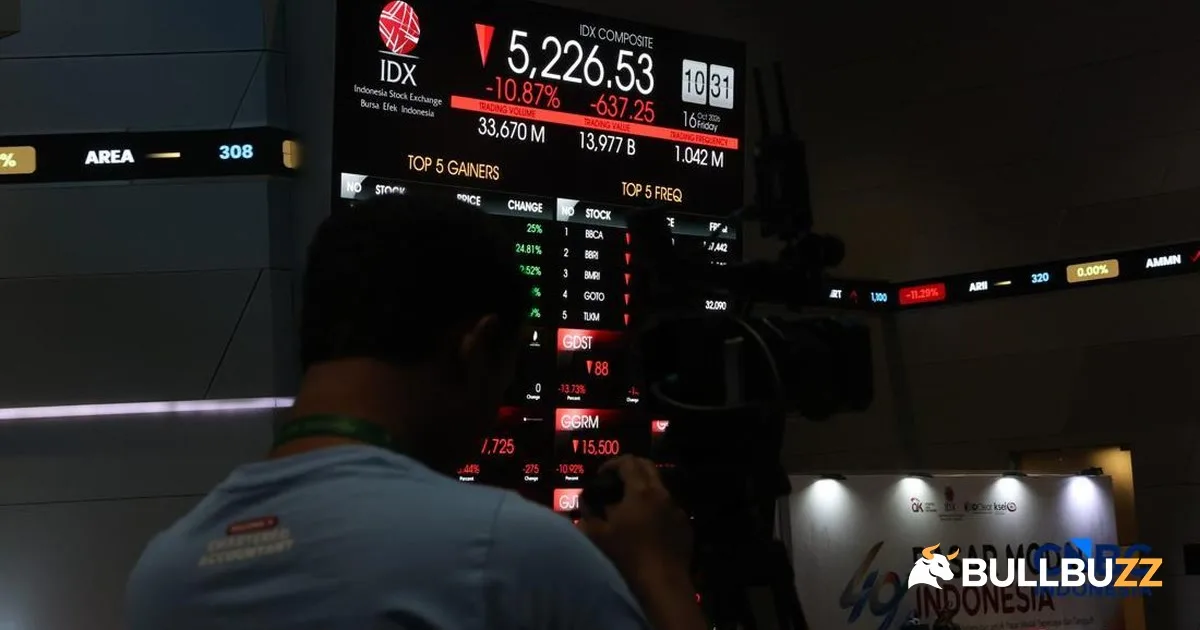
Indonesia's Jakarta Composite Index (IHSG) closed at 4,996.60 on Monday, down 3.64%, extending a selloff that briefly pushed the benchmark as low as 4,907.37 during the session.
The close left the index below the 5,000 threshold and followed Friday's 11.57% collapse. The latest session began with a 4.31% drop to 4,961.88 before the market recovered part of its intraday loss, according to Infobank's closing market report.
IHSG Closes Below 5,000 After Volatile Session
Monday's trading showed how fragile confidence remains. The index moved between 4,907.37 and 5,012.87, closing 188.49 points below Friday's 5,185.10 finish.
Market breadth was heavily negative:
- 656 stocks fell, while 100 advanced and 43 were unchanged.
- Trading value reached Rp25.12 trillion across 34.06 billion shares.
- Every sector ended lower, with basic materials falling the most at 4.57%.
- The LQ45 blue-chip index opened down 5.52% at 480.50.
The morning selloff was even steeper. The IHSG was down more than 5% near 4,900 during the first session, after opening 4.31% lower. CNBC Indonesia reported that major banks including Bank Central Asia, Bank Rakyat Indonesia and Bank Mandiri were among the large-cap names under pressure.
MSCI Review Remains the Main Market Risk
The decline followed MSCI's 15 October announcement that it had opened a consultation on moving Indonesia from emerging-market status to standalone status. MSCI said investors continued to report concerns over shareholding transparency, suspected coordinated trading and market enforcement.
The index provider will accept feedback until 30 April 2027 and plans to announce a decision by the end of June 2027. It also kept a freeze on several positive index changes for Indonesian securities, including additions to the MSCI Indonesia Investable Market Index and increases in certain foreign-inclusion factors.
That timeline matters. The proposal is not a completed downgrade, but the consultation increases uncertainty over how international funds may treat Indonesian equities. BullBuzz's earlier report on the initial 11.57% Indonesia stock-market plunge explains why the classification threat triggered such a sharp repricing.
Exchange Tightens the Downside Limit
The Indonesia Stock Exchange cut the lower auto-rejection limit to 7% from 15% for the period from 19 October through 31 December, according to ANTARA. The measure limits how far an individual stock can fall in a session and gives investors more time to process information during unusually volatile trading.
The tighter limit can slow the speed of a decline, but it does not resolve the governance concerns behind the MSCI review. Coordinating Minister for Economic Affairs Airlangga Hartarto said the market was reacting to negative sentiment and noted that the index had recovered from below 5,000 during the day.
Why the Indonesia Selloff Matters Across Asia
Indonesia is one of Southeast Asia's largest equity markets. A sustained loss of confidence can affect regional fund allocation, currency demand and valuations for companies that rely on foreign institutional capital.
The pressure also arrives during a volatile period for Asian equities. South Korea's recent 7.6% KOSPI rout showed how quickly crowded positions can unwind, while China's stronger 4.5% GDP growth has not removed concerns about uneven regional demand.
For Malaysian investors, the direct issue is exposure to Southeast Asian banks, commodities and index funds. The wider question is whether foreign investors treat the Indonesian shock as a market-specific governance problem or reduce exposure across the region.
What Investors Should Watch Next
The first signal will be whether the IHSG can hold near 5,000 without another wave of broad selling. Market breadth, foreign fund flows and the performance of major banks will show whether the pressure is easing or merely pausing.
Investors should also monitor any response from the exchange, the Financial Services Authority and MSCI after their discussions. Concrete progress on ownership disclosure, free float and enforcement would matter more than verbal reassurance.
Monday's late recovery reduced the loss from the session low, but 656 declining stocks and another close below 5,000 show that confidence has not stabilized. The next sessions will test whether the new 7% downside limit contains volatility while regulators address the concerns driving it.